AI GOVERNANCE
Are you governing your AI — or building the foundation underneath it?
21 August 2026 · 5 min read
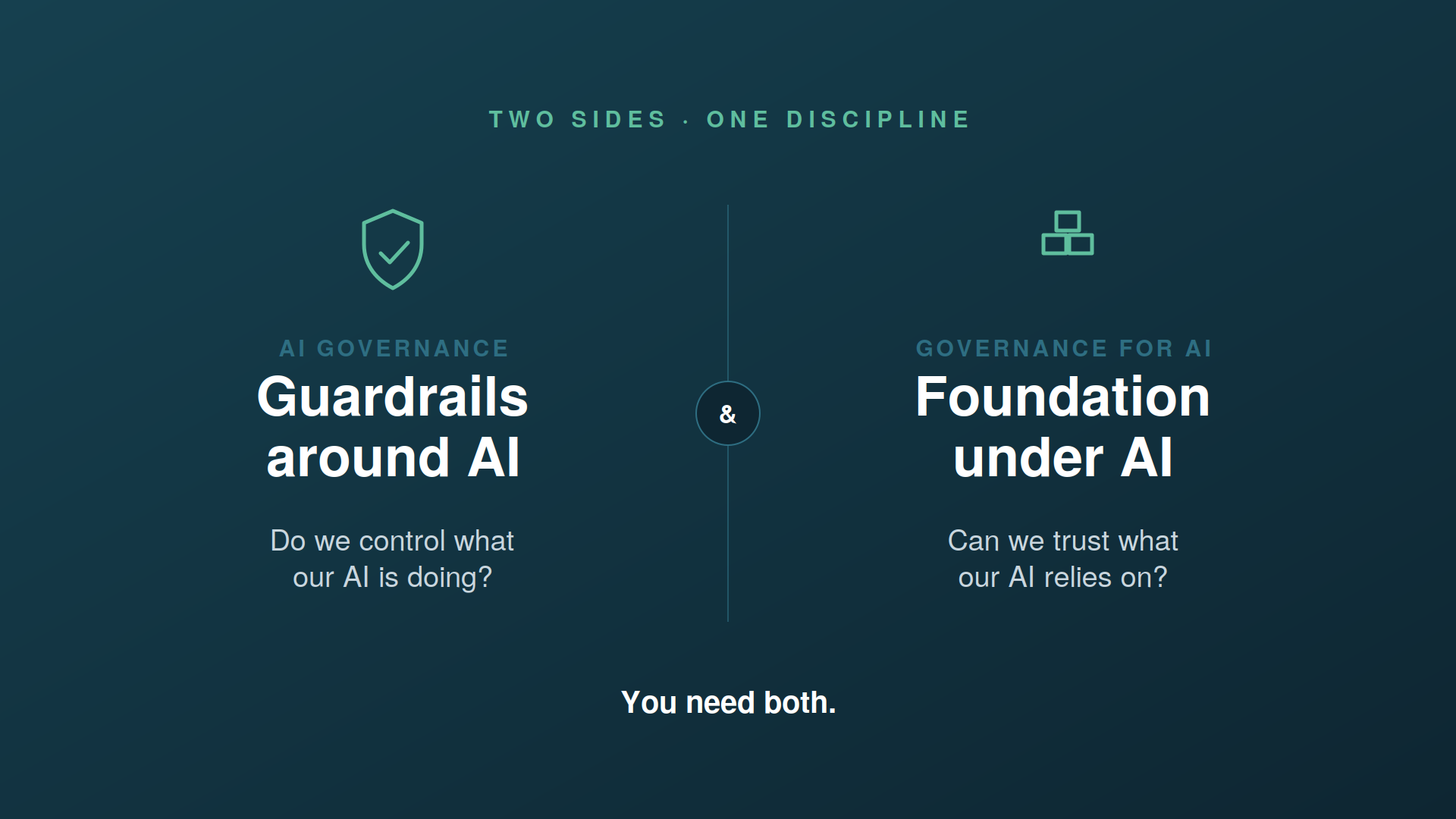
There's a distinction quietly reshaping how serious organisations think about AI, and once you see it, you can't unsee it. Ask a room of executives “do you have AI governance?” and most will nod — but they're often answering two completely different questions without realising it.
AI Governance asks: “Do we actually control what our AI is doing?” This is the world of guardrails — the AI itself, the models and agents making or shaping decisions. What is AI allowed, and not allowed, to do? Who is accountable when it makes a call? How do we assess and manage the risk before something goes live? Can we prove to a board, an auditor, a regulator or a customer that we're in control? Ignore it, and the loud consequence is fines and bad press. The quiet consequence is worse: nobody is watching what your AI does.
Governance for AI asks: “Can we actually trust what our AI tells us?” This is the world of foundations — not the AI, but everything it relies on. Is the data accurate and complete? Does the system have the right business context, or is it guessing? Do we know where the information came from, and whether we were allowed to use it? Ignore this one and the loud consequence is wrong calls and expensive rework. The quiet consequence is the most dangerous failure mode in modern AI: a system confidently making things up, at scale, with your company's name on it.
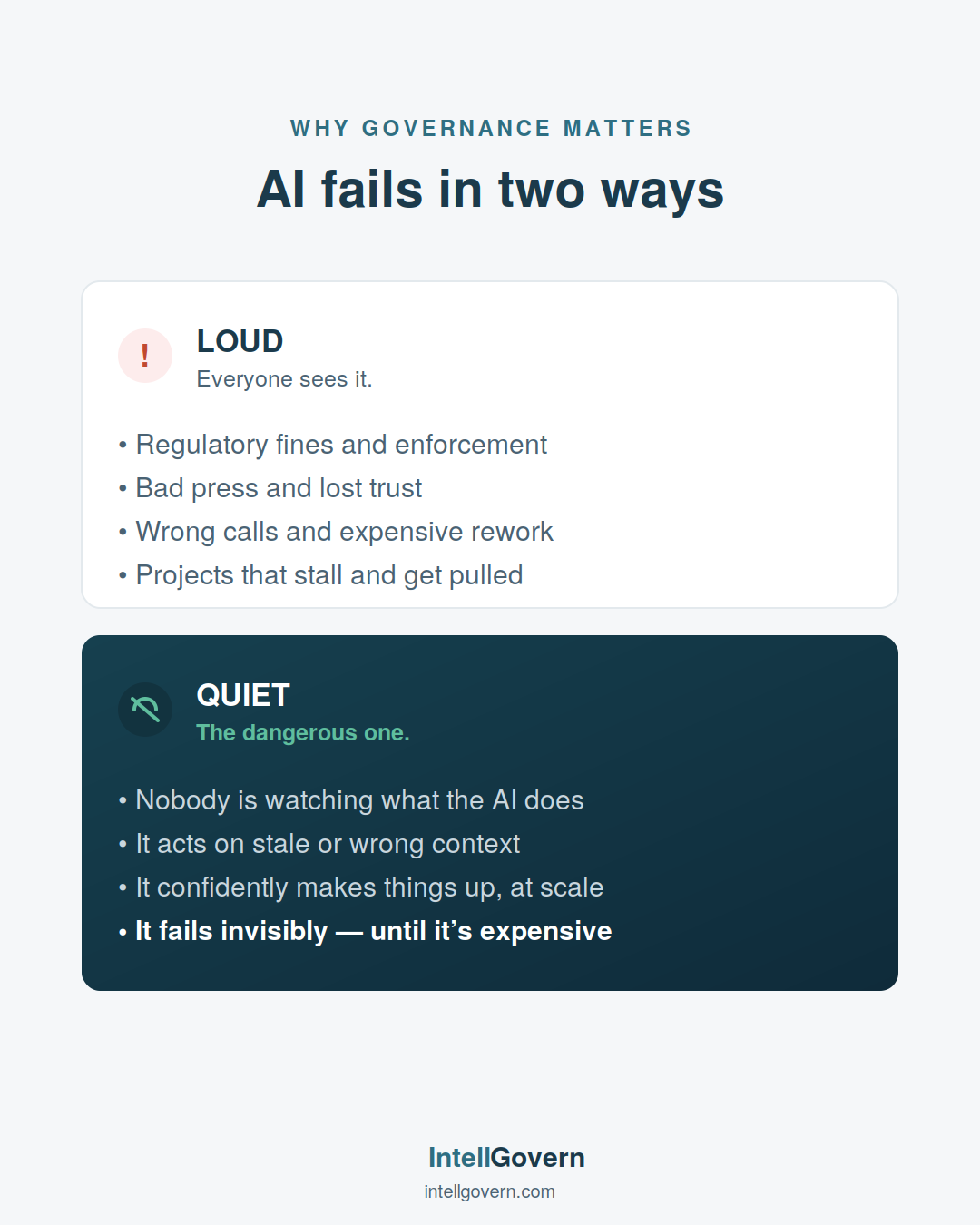
One is the guardrails around AI. The other is the foundation underneath it. You need both — and most organisations, honestly, have neither in any structured form.
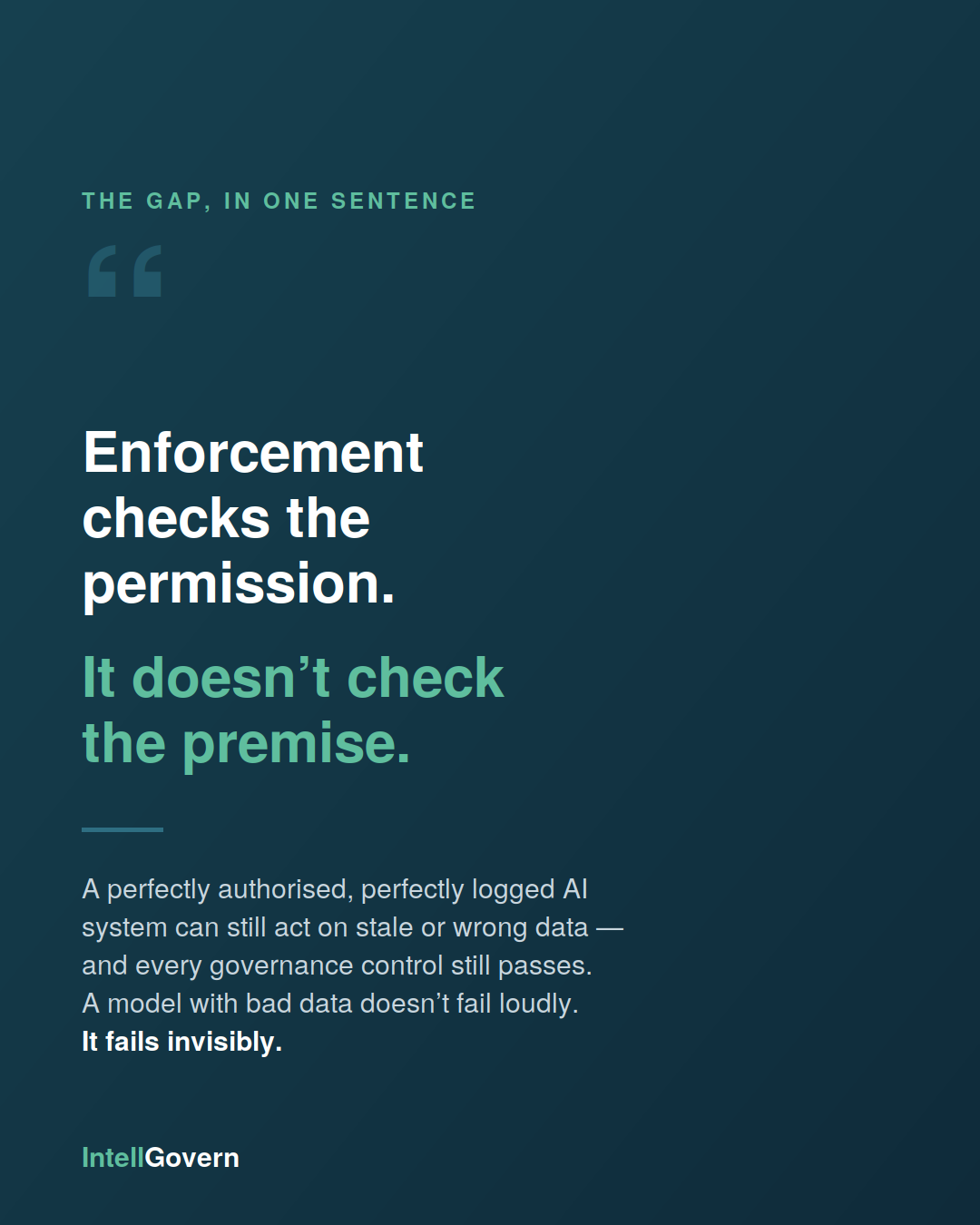
That's the gap in a sentence. You can have a perfectly authorised, perfectly logged AI system acting on stale or wrong context, and every governance control still passes. A model with bad data doesn't fail loudly — it fails invisibly. And it gets harder with agentic AI, where the system no longer just produces an answer but takes an action in your name. Now there are three questions: is it authorised to act, is it acting on information we can trust, and can we stand behind what it actually did?
Where IntellGovern fits. We deliberately start with the guardrails — because that's where the accountability gap is most urgent and where regulators are enforcing first. IntellGovern is the management layer for AI inside your business: every initiative goes through one gateway — intake, risk classification, controls, recorded approval — with a named owner and a full audit trail. Nothing goes live by accident. But because that intake asks, for every initiative, what data does this rely on, and could we defend it? — the guardrails make sure nobody skips the foundation. We won't claim to be a data-governance platform; that discipline deserves its own tooling. What we promise is that no AI enters your business without the foundation questions being asked, answered and recorded.
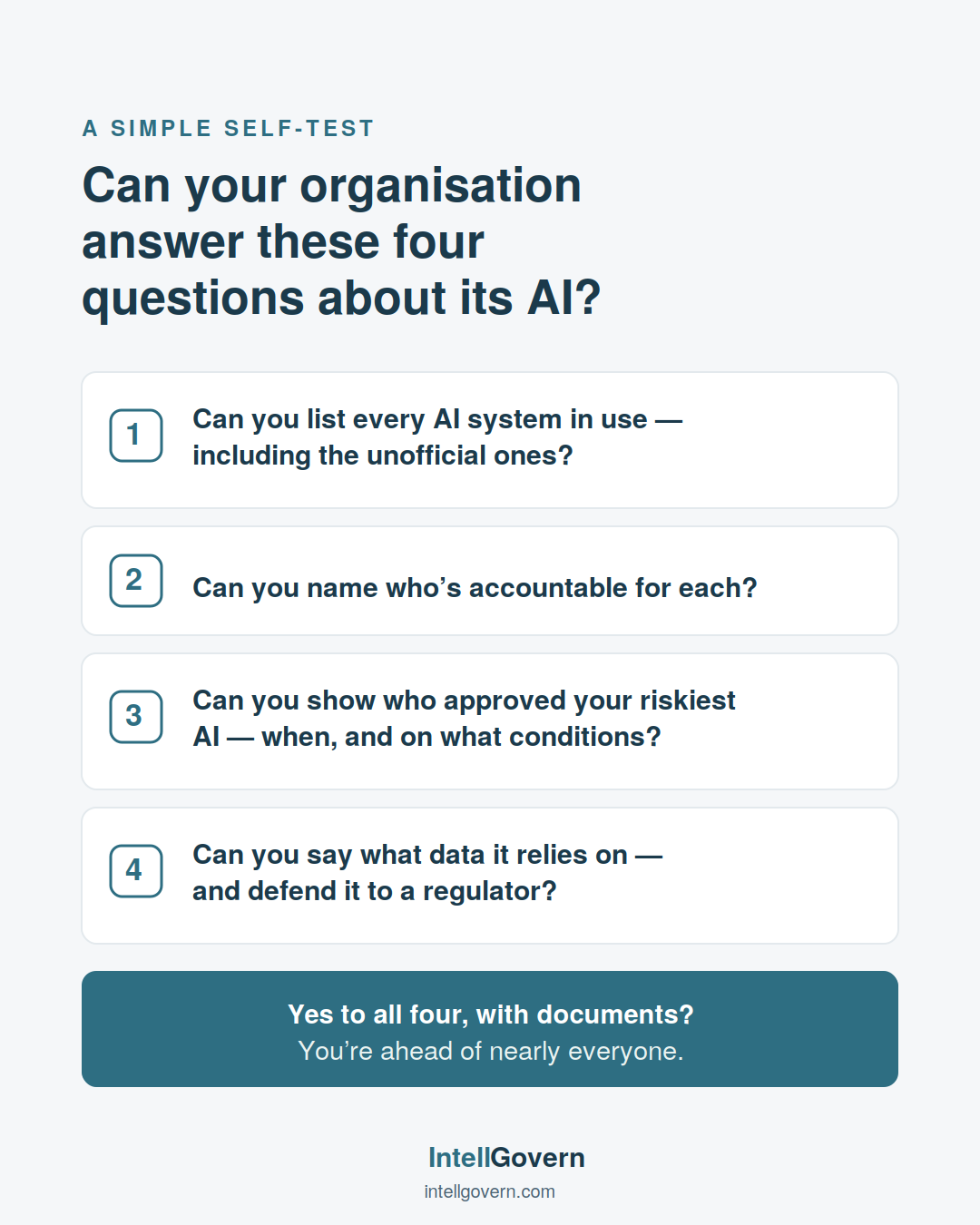
The simple test for your organisation. Forget maturity models for a moment. Can you (1) list every AI system currently in use in your business — including the unofficial ones; (2) name the accountable person for each; (3) show who approved your riskiest AI use, when, and on what conditions; and (4) say what data that system relies on and whether you'd defend it in front of a regulator? If you answered yes to all four, with documents, you're ahead of nearly everyone. If not, that's not a failure — the work just hasn't been given a structure yet. That structure is what we built.
Guardrails around AI. A foundation underneath it. You need both — and the guardrails are where control begins.