SHADOW AI
You can't govern what you can't see
21 August 2026 · 4 min read
Ask most leaders how many AI systems are running in their business and you'll get a confident number. It's almost always wrong — and it's almost always too low. Between the sanctioned tools, the AI features quietly switched on inside software you already pay for, and the staff pasting company data into public chatbots to get through their day, the real answer is usually “more than we think, and we're not sure where.”
This is the shadow-AI problem, and it's the reason so many organisations only discover their AI footprint after a risk has surfaced — a leaked document, a biased decision, a customer complaint, a regulator's question. By then, governance is cleanup, not control.
The uncomfortable truth is that every governance framework — every policy, principle and control you might adopt — assumes you already know what you're governing. Accountability, risk management, oversight: all of it depends on a complete picture of what AI is actually running across your operations. Without that picture, the most sophisticated framework in the world governs only the AI you happened to remember.
So the first job of AI governance isn't restraint. It's visibility.
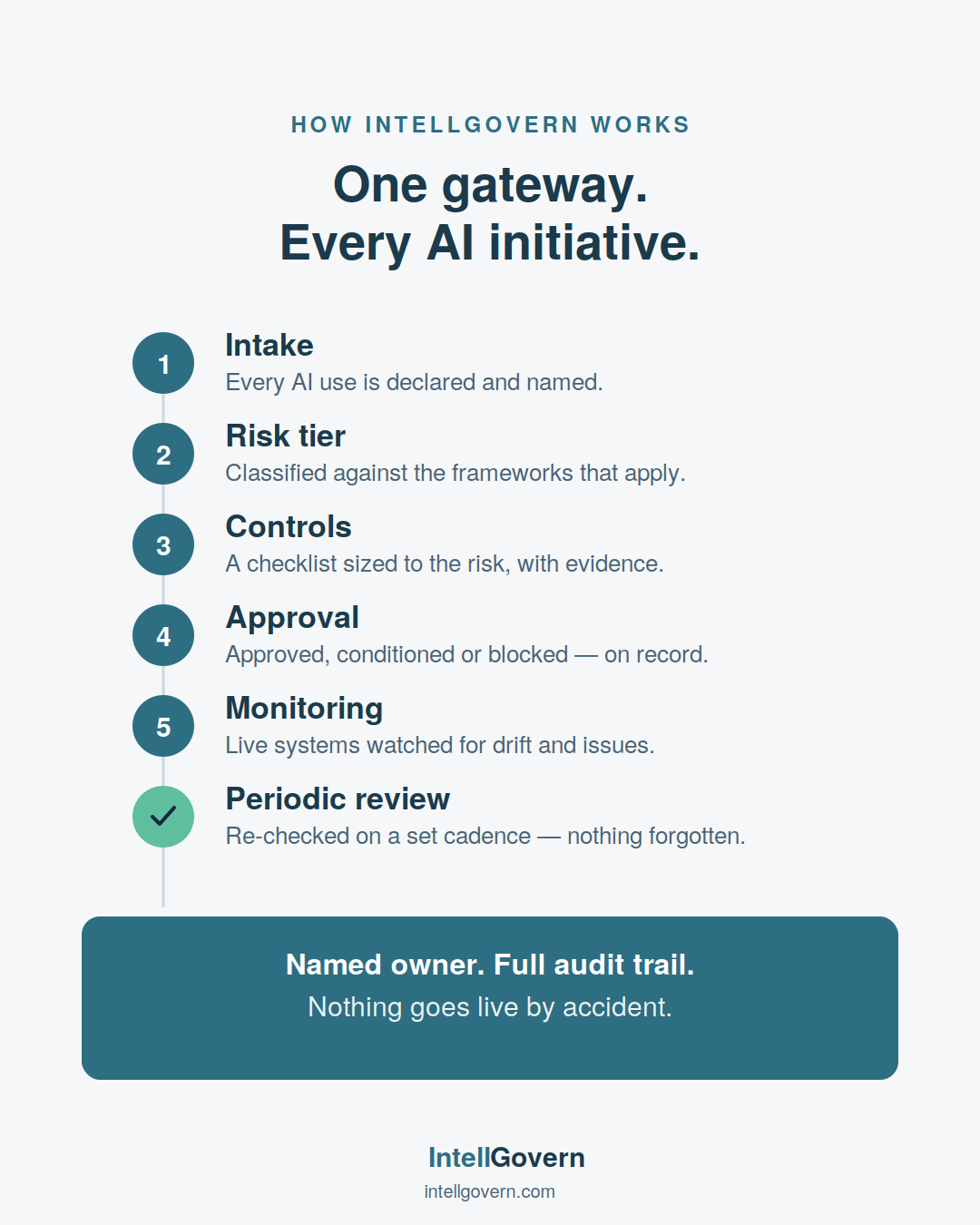
A policy tells you what should happen. An operating model governs how it happens. The difference matters enormously. A written AI policy that lives in a shared drive changes nothing about the tool a team spun up last week. What changes behaviour is a single, unavoidable route that every AI initiative has to travel — where it gets named, classified, reviewed and approved, with an owner attached and a record kept. That's not a document. That's an operating model.
That route is exactly what IntellGovern's AI Initiative Gateway is. Every AI use in the business — from a marketing chatbot to a credit-decision model — is registered, risk-tiered against the frameworks that apply to you, checked, and approved or blocked, on one living register. The moment shadow AI has somewhere official to be declared, and a reason to be, it stops being shadow.
Here's a small story that captures why this matters beyond compliance. When you automate the person who used to key in invoices, you also remove the person who would have noticed the supplier's bank details had quietly changed. The missed control is often the check nobody ever wrote down. Governance, done well, is what surfaces those invisible checks before they disappear — asking, for every initiative, what judgement used to live in the step we're now automating, and who owns that risk now.
You can't govern what you can't see. Start by making every AI system in your business visible — then the accountability, the risk management and the board-ready evidence you're being asked for become achievable instead of aspirational.
The simple first step: can you list every AI system in your business today? If not, that's where governance begins.