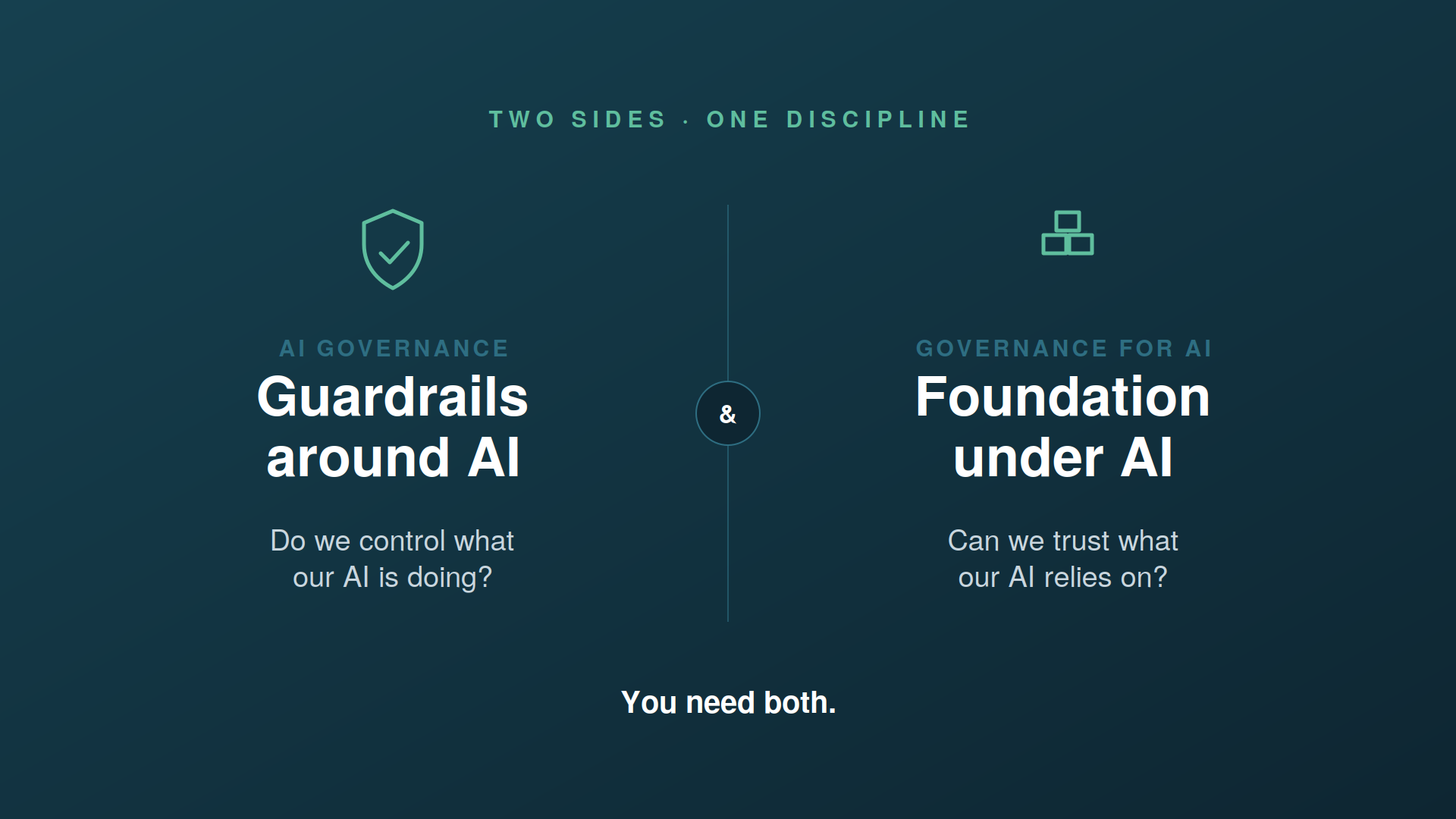
AI GOVERNANCE
Your AI subscription is not your AI governance strategy
Make AI Work · 30 August 2026 · 7 min read
We see the same pattern in almost every company we work with. Someone upgrades to a paid AI plan, the invoice clears, and everyone quietly assumes the data is now safe. Teams start uploading client documents, internal strategy, customer records, half-finished contracts. And the assumption becomes the exposure.
It is an easy mistake to make, because it feels like a decision was taken. Money changed hands. A “business” or “pro” label appeared on the account. Surely that means someone, somewhere, handled the data question.
Usually, no one did.
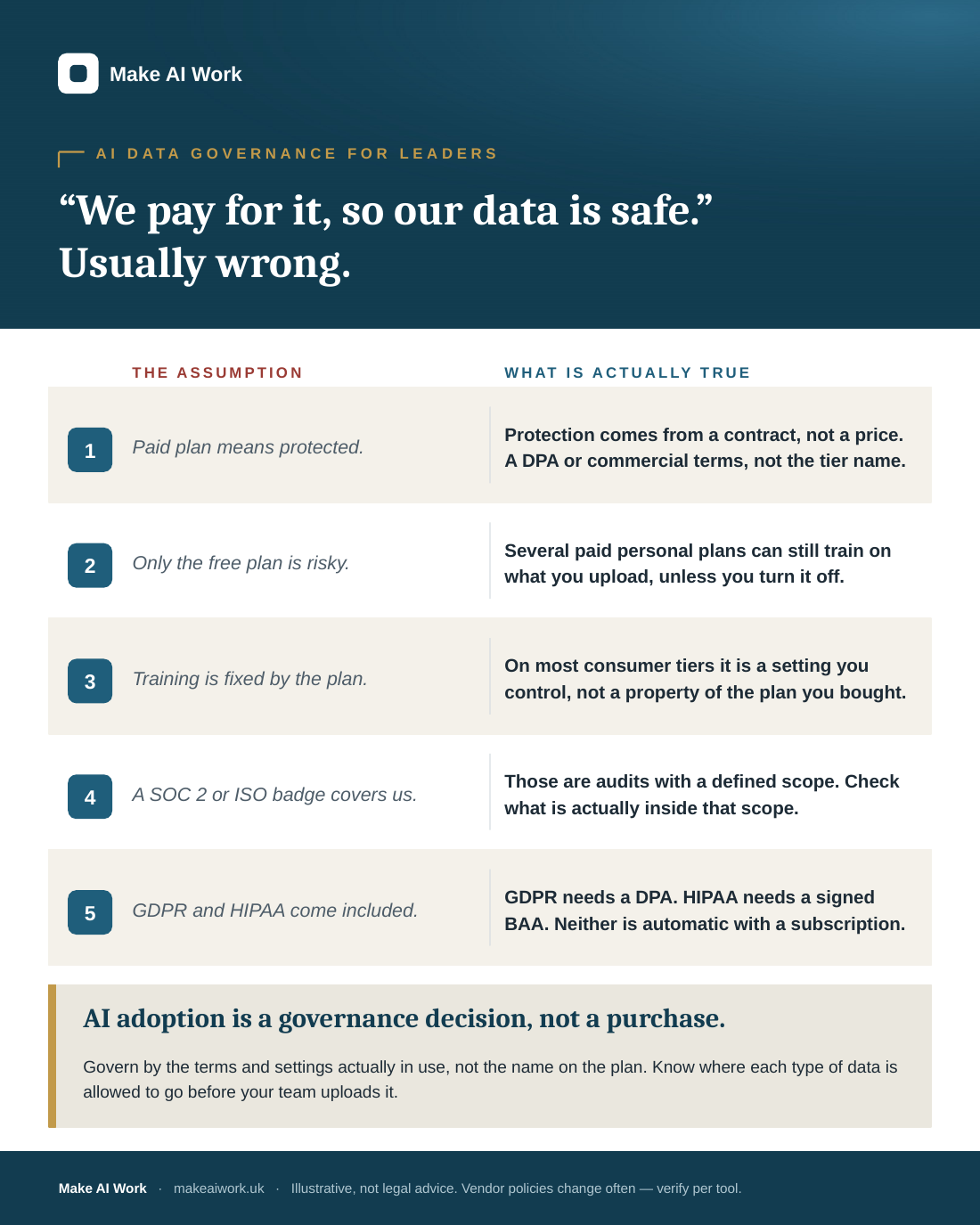
The uncomfortable truth is that a paid plan tells you almost nothing about how your organisation’s data is actually handled. It does not tell you what your team is uploading, which settings are switched on, which terms apply to your organisation, what data is allowed in which tool, or whether anyone could evidence those decisions later if a client, a regulator or your own board asked.
That is the real risk. Not that companies use AI. That they use it on assumption. “We pay for it, so we’re safe” is not a governance model. It is a hope.
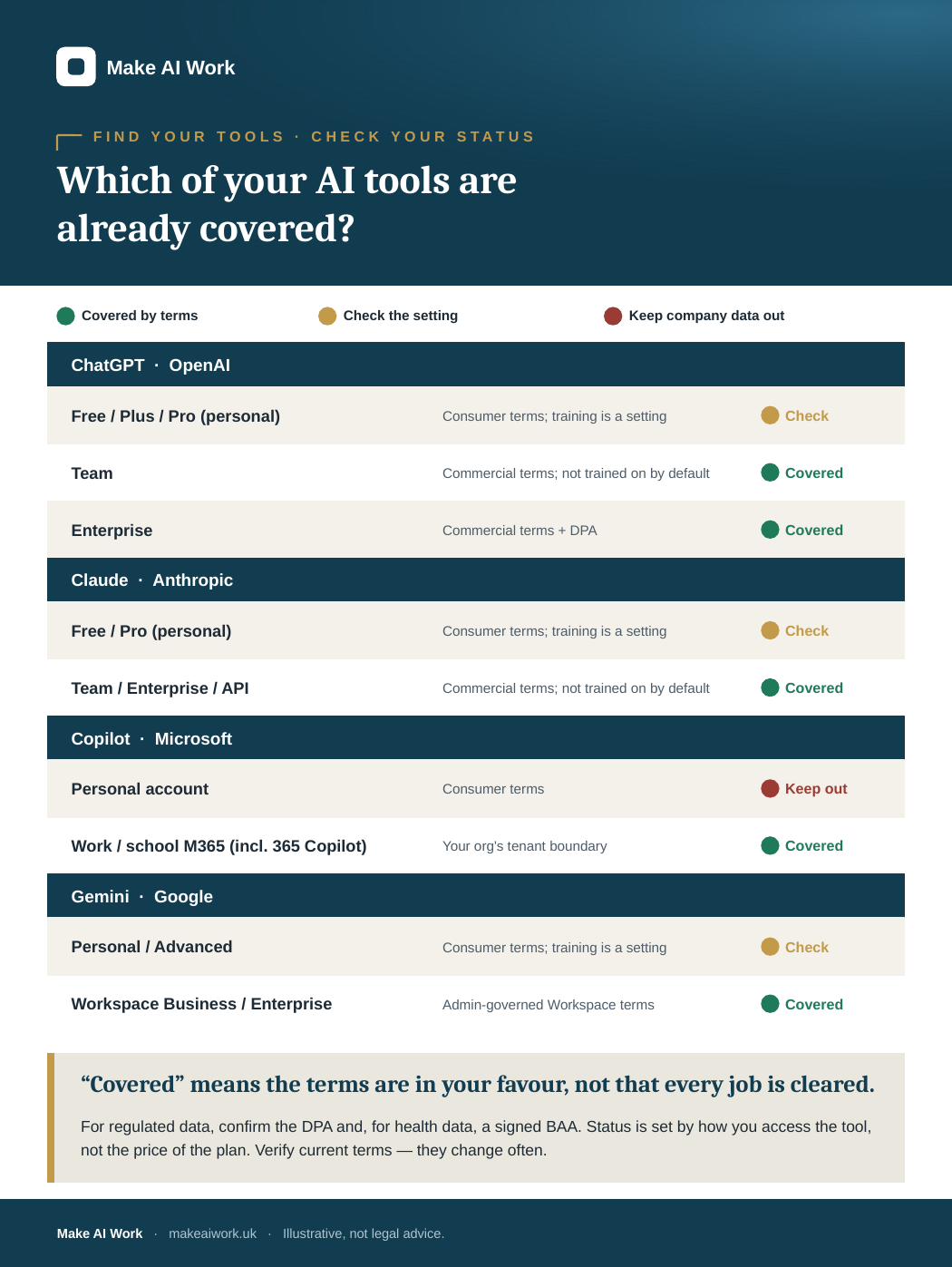
This article sets out what we tell every leader to check before their team uploads a single company file. Deliberately, it is not a grid of green ticks and red crosses. We have seen those circulating, and they are appealing because they promise a simple answer. But in practice the honest answer has more than two colours, and a table that flattens it into safe-or-unsafe usually creates a false sense of security rather than removing risk. What follows is the more useful version: the questions that actually decide whether your AI use is governed or merely paid for.
1. The plan name is not the protection
Pro, Premium, Plus, Business. These are marketing labels attached to price tiers. On their own they tell you very little about the legal and technical handling of your data.
What actually matters is the contractual and technical boundary around your specific account. Which commercial terms apply? Is there a data processing agreement in place? What retention, training and access commitments come with it? Two accounts paying similar amounts to the same vendor can sit under completely different terms depending on how they were set up, whether an organisation agreement was signed, and which workspace they belong to.
The practical move is to stop governing by the name of the plan and start governing by the terms and configuration in force. The label on the invoice is not the answer to the data question. It is not even a reliable clue.
2. Paid personal use can still be personal use
This is the one that catches the most organisations, and it is worth slowing down on.
A company card paying the bill does not turn an individual account into an organisation-governed environment. If a team member signed up with their work email, expensed the subscription, and started using it for company work, that account may still be governed by consumer terms. The billing is corporate. The data relationship may not be.
The questions that matter here are simple, and most organisations cannot answer them: Who owns the account? Which terms apply to it? Who controls the settings? Who can review the activity if something goes wrong? In many organisations, nobody has checked. The tool is in daily use, sensitive material is flowing through it, and there is no line of sight into any of it.
This is not a reason to ban the tool. It is a reason to bring it inside proper governance, on organisation terms, with an owner, before it becomes a problem you discover during an incident rather than before one.
3. The settings are half the story
Even where the terms are right, the configuration can undo them.
Controls for model training, data retention, sharing, history and connected third-party apps vary by plan, by workspace and by how the account was set up. Some default to the setting you would want. Some do not. Some changed default behaviour partway through the year, quietly, in a policy update almost nobody read.
The point is not that any one vendor is careless. It is that a setting you never checked is a setting you cannot rely on. If nobody in your organisation has looked at the configuration of the AI tools your team uses, nobody should be assuming those settings are in the safe position. Assumption is exactly the failure mode this whole article is about, and settings are where it hides most often.
4. A certification is evidence, not permission
SOC 2, ISO 27001, ISO 42001 and similar certifications are meaningful. They tell you a vendor submitted to an independent audit against a defined standard, and that matters.
But a certification is evidence that something was checked. It is not blanket permission for every way your people use the tool. A SOC 2 report has a scope. It covers particular systems, particular controls, particular commitments. It does not automatically clear every workflow, every data type, or every configuration in which your team might use the product. Nor does a certification tell you anything about your specific contractual position.
Treat certifications as one input into a decision, not as the decision itself. “They have SOC 2” is the beginning of due diligence, not the end of it.
5. Governance has to be live
Everything above shares a single weakness if you treat it as a one-time exercise: it goes stale almost immediately.
Policies change. Plans change. Vendor defaults change. The tools your team uses change, often faster than any procurement process can track. People change too, and the person who understood the setup leaves with the knowledge in their head. A governance document reviewed once a year and filed away cannot tell you what is actually happening in your business today. By the time it is opened again, most of it may be wrong.
This is the shift we spend most of our time explaining to leaders. AI adoption is a data governance decision, not just a tooling one. And governance in a fast-moving space is not a document. It is a living picture that keeps up with reality.
The real question
Put all five together and the question changes shape.
It is not “is this tool safe?” That question has no stable answer, because safety depends on the account, the terms, the settings, the data and the person using it, all of which move.
The better question is: “Can our people use these tools safely and consistently, and can we prove how company data is being handled?” That is a governance question, and it is answerable, but only if someone is actually keeping the picture current.
That gap, between the policy on paper and what you can actually show, is why we built IntellGovern. It is a live register of the AI tools in use across your organisation, the plans and settings behind them, the terms that apply, the data classes allowed in each, the owner responsible, and the review date. It turns a pile of scattered assumptions into a single view you can check, update and stand behind. Governance stops being a hope and becomes something you can evidence.
Where to start
You do not need a platform to begin. You need to be able to answer three questions honestly.
If someone asked you today which AI tools your team uses, which plan each is on, and what company data is allowed in each, could you answer with confidence?
For most organisations, the honest answer is no. And that is not a failure. It is simply the finding, and a good place to start. The companies that get ahead of this now, while the stakes are still mostly reputational rather than regulatory, will be the ones who can adopt AI quickly and defend how they did it. The ones who keep governing by the label on the invoice will find out the hard way that a subscription was never a strategy.